Links Roundup, September 2012 Edition

This week I come to you with links from the Internets. Most of these are recent, pulled-from-the-literary-headlines kind of stuff, but a few are older gems I’ve stumbled across that were just too damn wonderful or hilarious not to include.

Also, I’m inclined to use this post to shamelessly plug the OSU Press/The Journal Award in Poetry, the winner of which will be published and receive the $3000 ($3,000!!!) Charles B. Wheeler Prize. Entries must be postmarked by September 30th. Shameless plugging = accomplished.

Granta, which has just launched a Chinese-language edition of is magazine, apparently plans on adding more foreign editions to its catalogue in the future. Perhaps there will be employment opportunities for writers who speak more than one language. Très bien, non?

Phillip Roth recently got in a little tiff with the people of Wikipedia, who refused to allow him to edit the entry on his novel, The Human Stain. Apparently, the entry listed former The New York Times book critic Anatole Broyard as the inspiration for the novel’s protagonist Coleman Silk, but Mr. Roth cried “¡No es verdad!”

Salman Rushdie has been doing interviews to promote his new book, Joseph Anton, a memoir of his time in hiding during the fatwa against him. I caught his appearances on The Daily Show and Charlie Rose. I have a lot of respect for Rushdie as an artist, and was very glad to hear his comments on the recent, tragic events in the Libya. Check it out.

This video is from ten years ago, but it’s probably the greatest thing in the history of the world, ever. In it Gord Downie of the Tragically Hip acts out/reads “At The Quinte Hotel,” a poem by Canadian poet Al Purdy. “Your beer is half fart and half horse piss,” has got to be in the running for best line of the last decade.

Finally, I’m not here to hype OSU’s MFA Program (and not that the program needs it), but some of our alums have been getting themselves in the news recently. So here’s a review of Claire Watkins’ Battleborn in last Sunday’s The New York Times Book Review, and here’s Michael Kardos on The Huffington Post brilliantly discussing the differences between literary and genre fiction.

Good stuff. As always, thanks for reading. See you back here in a week or so.

Free Verse as Michael Myers: On the Ideology of Form

Hey there, The Journal blog readers. Today we have a guest blog post by The Journal issue 36.3 contributor Michael Shea, about a recent kerfuffle in the poetry world. Speaking of poetry, did you know that OSU Press and The Journal are putting on a poetry contest? Did you know that the winner of the contest gets the $3,000 Wheeler Prize? Well, as Bill Nye the Science Guy used to say, now you know. The contest deadline is October 1st, and you can find more info here. Get your submission on.

Is there something about election years that encourages poets to cast wide-angle narratives on the state of our craft? It seems these pieces are in abundance recently, the latest offering coming from Willard Spiegelman in the spring issue of Virginia Quarterly Review. Though on a fundamental level I disagreed with some of his points, Spiegelman’s essay was everything you could reasonably want from a critic (or a politician, for that matter): measured, informed, well-structured, humble and transparent in its biases—which is why it’s such a shame that VQR decided to follow-up on that article with the alarmist response from William Childress, entitled “Is Free Verse Killing Poetry?” The basic argument in Childress’ article, which is not even entirely coherent, is that the preponderance of free verse has restricted not only our understanding of the craft and the possibility for “memorable poetry” but the appeal of poetry in general. The question for us, then, becomes which absurd claim to address first.

Childress goes to, well, very few lengths to show that free verse has none of the power of formal poetry, citing four lines of Howl (which he reads with more than a little latent homophobia) and one poem by Asturo Riley in support of his claim that free verse’s record of important work is “spotty,” before moving on to the same tired critiques of slam (which he calls a “circus”) and academic poetry that have been repeated ad nauseum, the former coming with a hefty dose of condescension that feels utterly classist. Even leaving aside the fact that he’s (purposefully) vague with regards to what constitutes this not-free-verse—does he want meter? rhyme? form? some confluence of the three?—and correspondingly, what we can rightly claim to free verse’s credit (as gray areas abound), we have to take issue with an argument that ignores free verse’s ability to interrogate natural rhythms of speech, especially one that sees Eliot, Stevens, Williams, Ashbery, O’Hara, and countless others (and this is just the list of old white men)—in short, some of the most widely-read poets in English—as forgettable.

In fact, I’m not even sure there are sufficient grounds for his central objection—that the barbaric, anarchist Free-versers are stifling the good people of Formaltown. Perhaps most telling is that midway through the essay, Childress himself admits that he doesn’t “read much modern poetry.” That’s painfully obvious. Because if he were reading, he’d know that Annie Finch and Maurice Manning (who grabbed a Pulitzer nomination a few years back) write most of their poems with strict metrical or formal regularity. That contemporary poets—and good poets—like Ben Lerner and Sandra Simonds are writing sonnets—true sonnets, to not even mention people like Nick Demske and K. Silem Mohammad, whose work constitutes a new investigation of the form. Formal poetry may not have the hegemonic grasp it used to, but given its continued relevance, Childress’ complaints sound like those of the Religious Right, crying oppression just because their monopoly has eroded (to which experimental poets have to reply, “You think you got it bad?” This is, truly, no country for Charles Olson). Moreover, his allegations that poets are not engaged with current events or that formal poetry is not taught anymore are downright laughable. To the former, we need only to look to the hundreds of readings given in the wake of the 2010 Gulf oil spill; as for the latter, I’m not so far removed from high school that I can’t remember the poetry unit consisting of the usual suspects—Frost, Dickinson, Shakespeare, Donne. And to the claim that the supposed disappearance of formal poetry somehow relates to poetry’s declining readership, while I see a lot of value in formal poems, I find it hard to believe a regression to 19th Century language patterns will inspire any new readers from a generation raised on Twitter and absurdist comedies—or, to quote one of my students: “What we learned in high school was boring.”

But my circle-the-wagons rhetoric aside, and with no real disrespect implied to the great formal poetry of history nor its current practitioners, what’s truly important is what the article fundamentally overlooks: that the decision between writing free verse and writing in any kind of prescribed form is not a question of laziness, lack of education, or self-obsessed narcissism. It’s one of ideology, which is not to say that specific meters or forms endorse specific ideologies (a ridiculous claim, given how different a Frost sonnet is from a Demske sonnet, on so many levels), but to suggest that the presence of a regulating artifice—whether that be meter, rhyme, villanelle—carries with it a loose ideological backdrop about language and how it orients the speaker to the world by suggesting a sort of overarching order or the possibility of developing and maintaining such an order through language, even if that order is posited simply to be rejected. And this is important not because I wish to cast formal poets as fascist arbiters or out-of-touch conservatives—they’re not, or at least, if they are, it’s not because of their poetics—but because the decision to adopt or abandon this sort of ideological baggage is a central part of a writer’s vision. Okay, so perhaps not everyone writing free verse sees it in those terms—surely my undergraduate workshops don’t focus on the rhetorical underpinnings of iambic pentameter—but the contemporary poets worth reading (and in my idiosyncratic view I count among them Joyelle McSweeney, John Taggart, Cathy Wagner, and Tim Earley, just to name a few) are hyper-aware of the ways in which their formal choices (that is, to mostly reject prescribed forms) bear on their work. It is this inability to conceive of free verse as a distinct formal choice, and the corresponding willful ignorance about the implications of form beyond the fact that it makes a poem look and sound nice, that marks the deepest failing in Childress’ piece.

Despite all this, I think Childress is right about a few things. For example, we may well be living in a one-poetry nation. I wouldn’t disagree with the idea that we could use an injection of new life into our culture of slavish devotion to mimesis and metaphor, one that’s constructed hagiographies around poets of immense talent but perhaps limited or now-tired vision (Levine and Plath come to mind). I think a greater celebration of rhetoric, of sound, of irreverence, of non-discursive elements, of found text, of a specific refusal of perfection—some of which might involve a greater discussion of meter and form—would be welcome, at least for me. Nor do I begrudge Childress his self-appointed status as a malcontent—poetry desperately needs those people. But it also needs them to know what they’re talking about.

Announcing The OSU Press/The Journal Award in Poetry: An Interview with Kathy Fagan

Kathy Fagan is a professor in the Creative Writing Program at The Ohio State University. She has received fellowships from the National Endowment for the Arts, the Ingram Merrill Foundation, and the Ohio Arts Council and is the author of four books of poetry: The Raft (1985), which won a National Poetry Series Award, MOVING & ST RAGE (1999), which won the Vassar Miller Prize for Poetry, The Charm (2002), and Lip (2009). Currently, she is working on her fifth collection, entitled Sycamore, from which poems have recently appeared in FIELD, Cimarron Review, The Awl, and The Laurel Review.

Kathy is serving as this year’s judge for The Ohio State University Press/The Journal Award in Poetry; and she recently sat down with Poetry Editor Michael Marberry to talk about all things poetry-contest—including how she approaches the responsibility of judging manuscripts, some tips for writers who are putting together a manuscript for the first time, and some writers whom she is currently reading.

Kathy Fagan Photo

Michael Marberry: Kathy! Thanks for taking some time to talk about the upcoming poetry book prize from The Journal and OSU Press. Before we start, here’s a true story: I once helped you and your husband move some heavy furniture, exercise equipment, and whatnot. Take a brief moment, for our readers, to laud my impressive feats of strength on that day.

Kathy Fagan: I believe those feats were iambic feats.

MM: Ha! Yes, that sounds right. I will take that as a compliment, thank you. Speaking of poetry, iambic and otherwise, you’ve written four excellent collections at this point in your writing life; and you’re well on your way toward completing your fifth collection. What advice would you offer to someone else about creating a manuscript?

KF: At this point, I can honestly say that each book demands a different kind of preparation, but my best overall advice to newer poets: Don’t rush. Take your time writing individual poems and getting feedback on them before contemplating a manuscript. Second, in most cases, it’s best for the manuscript to be shorter rather than longer. Include only the poems that still speak to you and that speak most directly to your subject or aesthetic. All that said, I suggest employing a cautious recklessness in the ordering of poems. Making a book is like making a new poem. It should be just as textured, strange, and satisfying. And, like a poem, a manuscript should begin promisingly. What you’ve heard about front-loading your manuscript is true. It works. It sets the tone and anticipates its reception.

MM: That seems like really keen insight. But your response made me wonder about something—particularly about poems that speak directly to a subject or aesthetic. I tend to see that idea at work in lots of contemporary poetry collections—i.e. books with clear, cohesive “parts” and even quite a few collections that follow a singular subject and aesthetic throughout. Just to play devil’s advocate here for moment: Is there a place in poetry today for what we might call a dissonant manuscript—that is, a collection that oscillates wildly, even joyfully, between different subjects and aesthetics? Or are we in an age of the poetry “concept-album,” where every poem in a collection really ought to be consistent, either in its adherence to a similar subject or in its mode of expression?

KF: Great question. Anyone who knows me knows that I nurse a pet-peeve against high-concept anything and love me an old-fashioned “collection” of poems. I am also known to write a wide range of poems myself and to possess, as an editor and a teacher, a pretty eclectic and even catholic taste. But when I say subject or aesthetic, I mean those terms in the context of organizing principles. And one needs to craft a manuscript, “dissonant” as you call it or otherwise, in as careful and layered and interesting a way as one structures a poem. The choice of the first poem, eighth poem, fourth section, final poem, whatever—none of that is random. It’s not consistency that I’m looking for but control and abandon in all the right places—an overriding intelligence that assures me that I’m in for an experience that only this particular book can give me.

MM: That’s very interesting to hear. So . . . with that in mind, who are some of the writers that you’ve been reading and admiring lately and why?

KF: When I was in Brazil this summer, I visited the Portuguese Language Museum—a marvelous place. One exhibit featured the novels of Jorge Amado and, because some of the content in them is sexually explicit, there was one room saturated in red light with peep-show vents in the walls. If you looked through the vents, you could read a sexy passage. It made me wish that we had such a thing here in the States. Anyway, I’m reading Amado in translation right now.

I’m also reading poems by Marosa di Giorgio in translation. And scads of shockingly good work by former students and friends of students with new books: Betsy Wheeler, Letitia Trent, Ida Stewart, Natalie Shapero, Daniel Carter, Allison Davis. I have a stack of books that I’m working through by Noelle Kocot, Amanda Nadelberg, and the wonderful Sabrina Orah Mark.  I’m also reading Mary Ruefle’s essays.

What I admire is a certain shapeliness of image and phrase that can best be described as painfully astute and psychologically adventurous.

MM: This year, you’re judging The OSU Press/The Journal Award in Poetry.  For our readers who may not know, you have some connections with The Journal, as you were the Poetry Editor here for over 20 years, which I hear is actually something like 100 years in the life of an editor. How did you manage to maintain your writing prowess, your sanity, and your good looks throughout all that? What’s your secret?!

KF: Why thank you, Michael! No wonder you have my job now. I loved editing The Journal, and I made many, many strong and enduring poetry friendships with contributors and student editorial assistants alike during my time there. Those relationships and finding good poems made it all worth the crunch of production and the financial stress. I feel as if Michelle Herman and I did something really important during those years—just as you do now. Editing can be a generous, collaborative, creative, and generative activity.

MM: That’s interesting to hear you talk about editing as a collaborative process. Am I wrong in assuming that you’re not just talking about collaboration among staff-members but also a spirit of collaboration among editors and submitters/contributors as well? And, thinking particularly about the poetry book contest, to what extent do you approach those submitted manuscripts in a similarly collaborative manner? Or, in your mind, is a judge’s job in some way different than an editor’s?

KF: Yes, you’re absolutely right in assuming that the collaboration I’m talking about is between an editor and a writer. To be in a position to steward work into print when it’s not your own work is both utterly selfless and entirely selfish. I mean, the editor gets to say, “Your work slays me, and I have a hunch it will affect others in the same way. Let me put it in my shop window. But it’s my shop window, right, and everybody has to stand in front of it to see this great thing that I found of yours.” Between an editor and reader, too, there’s this wonderful social contract in which the editor says, “Lookit! Lookit! You’re really gonna love this poem I found for you!” I don’t know . . . maybe I need to join a circus, but I love being able to hawk what I find beautiful to people who might not otherwise find it.

Judging is a less intimate activity than editing for me and a heavier responsibility. I’m led toward the ultimate winner by asking questions such as: Is this a manuscript that will most fully round out, enhance, brand, or diversify the OSU Press poetry list? How is it like or unlike the recent winners of the OSU Press / The Journal competition? How is it like and unlike new books that I’ve read in the past year or two? How does this manuscript represent the prevailing aesthetics of The Journal, if at all? Does the world need more poetry collections about this subject or has that trend run its course? How great of an impact will this book have on poetry readers? My choice is about gut-feeling, but it’s also an instinct informed by lots of experience, plus a handful of practical issues.

It’s exquisite to identify those two dozen instantly publishable manuscripts, excruciating to narrow those down to one, and joyous to make the phone call saying, “You win!” I love that part.

For more information about how to submit your full-length poetry collection to the contest during the month of September, please visit the OSU Press website.

Best New Poets 2012

On August 21st Best New Poets announced their winners for 2012, and the lineup included several scribblers who have recently been affiliated with The Journal, including: Tory Adkisson (former The Journal poetry editor), Oliver Bendorf (featured in The Journal 36.1), Michael Martin Shea (featured in The Journal 36.3), Chris Tanseer (featured in The Journal 36.1), and Jane Wong (featured in The Journal 36.3). Lots of celebrating to be done in the name of our contributors and former editor (and a note to contributors, if your work receives accolades elsewhere, let us know about it at online@thejournalmag.org, and we’ll chat you up on Twitter, Facebook and/or our blog).

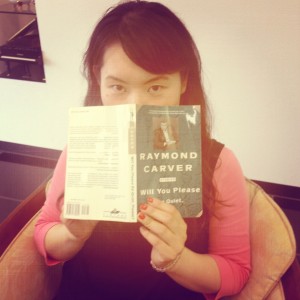
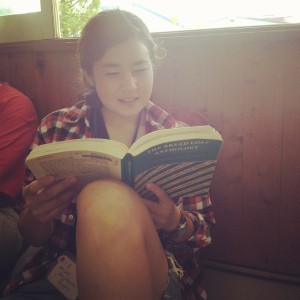
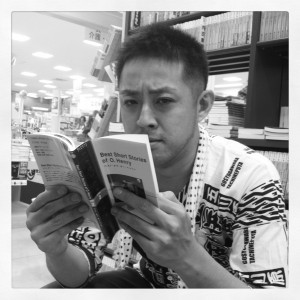
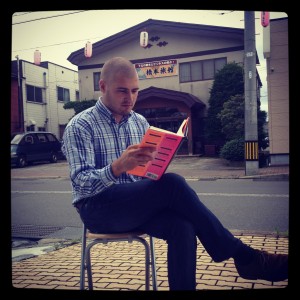
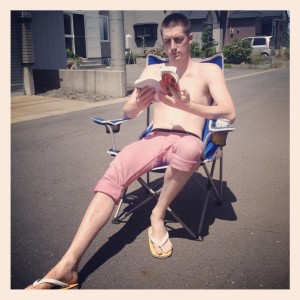
An Ode to Summer Reading, in Pictures
Will You Please Be Quiet, Please? by Raymond Carver
The Breadloaf Anthology
Best Short Stories of O. Henry
The Liar's Club by Mary Karr
What We Talk About When We Talk About Anne Frank by Nathan Englander
The Circus Fire by Stewart O'Nan
2012 Fiction, Nonfiction, and Poetry Contest Winners

The Journal editors are delighted to announce the 2012 contest winners in fiction, nonfiction, and poetry! The winning story, essay, and poem will appear in issue 37.1, our Winter 2013 issue, available in January 2013.

Fiction:

Leslie Parry, author of “Old Pretty”

Leslie Parry photo

Leslie is a graduate of the Iowa Writers’ Workshop. Her stories have appeared in The Missouri Review, Cream City Review, Indiana Review, Virginia Quarterly Review, and The PEN/O. Henry Prize Stories. She was recently the writer-in-residence at the Jack Kerouac House in Florida.

Fiction contest judge Christopher Coake says:

This was a tough contest to judge, but in the end I couldn’t choose any winner but “Old Pretty.” It’s a simple story—one summer afternoon, two young sisters go swimming together at a city pool, still reeling from their father’s abandonment and the subsequent loss of their mother to grief. The narrator, from a point in the future, tells us how, that day, she gave into selfishness and cruelty, via a story suffused with both the whimsical minutiae of girlhood and a mature mind’s regret. What makes the story truly exceptional is its language. After her sister’s hair falls out, the narrator “was finding clumps around the bathtub drain, in static tantrums on the pillowcase.” After a slap, the narrator heads to the bathroom, “my cheek fizzing-hot and neon scribbles in my eyes.” This is highly literary writing—which is not automatically of benefit to every story. But here the beautiful, odd, fussed-over prose suggests a hard truth: that our narrator, like many of us, so needs her family that even her old and painful memories of it have, in time, become precious treasures.

Nonfiction:

Suzanne Richardson, author of “Oh, Niagara!”

Suzanne Richardson photo

Suzanne Richardson earned her MFA at the University of New Mexico. She currently lives in Utica, New York where she is an Assistant Professor of Creative Nonfiction at Utica College. Her work has appeared in New Ohio Review, New Haven Review, Blood Orange Review, Front Porch, and MAYDAY Magazine. It is forthcoming in High Desert Journal and Southern Humanities Review. Find more of her writing at: www-suzannerichardsonwrites.tumblr.com/.

Nonfiction contest judge Sonya Huber says:

“Oh, Niagara!” takes on, at first, what seems to be a small and innocuous event—a trip with the narrator and her parents—and gradually unfolds the trip’s scenes in a nonlinear fashion that encloses larger themes and concerns. The reflection is particularly beautiful, and although the essay touches on familiar topics of family, anxiety, love, and the unknown future, it steers away from the sentimental and toward the surprising at every turn. I found myself captivated by the writer’s ability to weave in research and to use these facts judiciously and meaningfully in service of the essay. The suspense and surprise of this essay originates in the writer’s consciousness and her direct and trustworthy voice, both of which propel the reader through the pages and into scenes that reach into moments of vulnerability that ring true to life.

Poetry:

Emilia Phillips, author of “In vacuo, Universal Studios”

Emilia Phillips photo

Emilia Phillips received her MFA at Virginia Commonwealth University and serves as the associate literary editor of Blackbird. Her poetry has appeared in many journals including AGNI, Hayden’s Ferry Review, and The Kenyon Review. She recently completed her first manuscript Signaletics in which “In vacuo, Universal Studios” appears.

Poetry contest judge G.C. Waldrep says:

In vacuo, Universal Studios” makes of the most prosaic experience—standing in line at the eponymous attraction—an ecclesiological event: if not an act of worship outright, then a prelude to worship, to a worship that may in fact never occur (“We begin in line. We end there.”). Breaking gently through the texture of experience is an incipient elegy for the speaker’s father, in whose “temple, / in the heat, a vein is swollen,” a being who “sweats / through his clothes.” Love resides “at terminus,” but in this poem “terminus” is a place the human, shuffling forward along Zeno’s benighted paradox, may never reach.

Thank you to everyone who submitted to our 2012 contests!

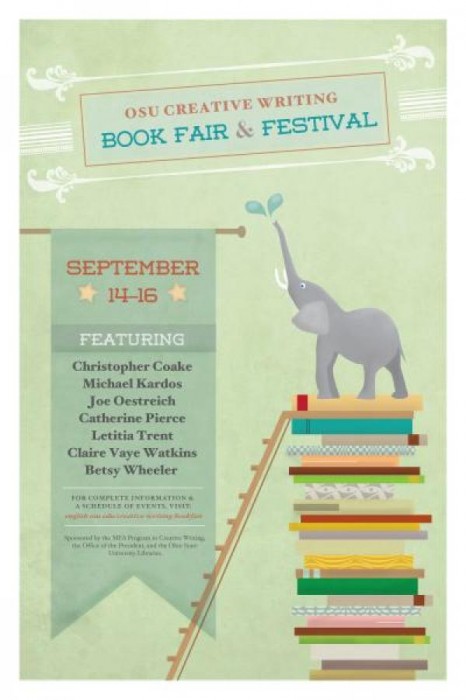
OSU MFA Creative Writing Bookfair & Festival

For the first time ever, Ohio State’s MFA program will be
holding a book fair and festival featuring talks, readings, and signings by former MFA students..(Details here). This three-day event will begin on September 14th and will include several graduates with forthcoming books, such as Christopher Coake (You Came Back), Michael Kardos (The Three-Day Affair), Joe Oestreich (Hitless Wonder: A Life in Minor League Rock and Roll), Catherine Pierce (The Girls of Peculiar), Letitia Trent (One Perfect Bird), Claire Vaye Watkins (Battleborn), and Betsy Wheeler (Loud Dreaming in a Quiet Room).

Poster by Thao Thai.


We’ll also welcome back OSU stars Donald Ray Pollock (Knockemstiff, The Devil All the Time), winner of the PEN/Robert Bingham Prize for a first work of fiction; Natalie Shapero, author of the upcoming No Object and current Kenyon Review fellow at Kenyon College; and Ida Stewart, author of Gloss and winner of the 2011 Perugia Press Prize for a first or second book of poetry by a woman.

The festival, in addition to talks and signings, will include panels of extremely high interest to aspiring writers and literary connoisseurs. These panels will touch on topics such as publishing a first book, finding and keeping a tenure-track university job, online publishing for poets, genre versus literary novels, and the transition from story collection to novel, as discussed by writers whose first published works were collections.

All in all, this is a great chance to enjoy, (and in my case, learn from), the writings and ideas of Ohio State’s publishing luminaries. We’re honored to have them home.

Ten Books to Look Out for in the Second Half of the Publishing Year: 2012 Edition

Here we find ourselves, already past the halfway point of 2012, and I thought it an appropriate time to take a look at what the next six months or so of publishing has in store for us. The first half gave us Nathan Englander’s superb What We Talk About When We Talk About Anne Frank, Richard Ford’si Canada, Lee Martin’s Such a Life, and another historical novel from Hilary Mantel. We were also privy to the whole John D’Agata controversy and the hullabaloo surrounding Fifty Shades of Grey. I hope that the literary world stays this entertaining through the holidays.

Steven Millhauser recommended.

In keeping with traditions sacred and mysterious, I’m going to limit my listing to ten lucky books, so pre-apologies to anyone left off. Also, you’ll notice a dearth of poetry among my choosings (I thought about including Frederick Seidel’s new volume on the list because I—knowing next to nothing about poetry—enjoy his work, but then I didn’t want to upset all the poets who’ve told me I’m mistaken in my regard for him) so, again, apologies; I thought it best to confine myself to the realms I’m familiar with. I implore poets to let me know what titles they’re looking forward to in the second half of 2012 in the comments. Finally, let me say that I know my interest in book lists is sick and wrong and goes against everything my liberal arts education was supposed to instill in me—I know that such lists simplify a whole six months of publishing and reading into a few paragraphs and focus on certain books and not others for all the wrong reasons, and I know they’re a poor substitute for the slogging through of the literary marketplace that a diligent reader is supposed to do on his or her own—but damn it, I like them anyway.

So, in no particular order, here are ten books I’ll be keeping my eyes peeled for in the second half of 2012:

Woes of the True Policeman—I don’t know what it is about Roberto Bolaño, but I can’t resist his prose. Even when his plots go nowhere but in circles, and some of the characters are all just thinly disguised tough guys, and even when the work is something of a mess that Bolaño left unfinished when he died. Even Monsieur Pain (2010), which left me feeling like someone had dumped a box of puzzle pieces out on the floor of my living room, had that weirdly intoxicating feeling. Maybe that’s just the anticipation that a reader feels when they think they might be reading a book that reaches the same heights as The Savage Detectives (2007) or 2666 (2008). (Comes out November 13th 2012.)

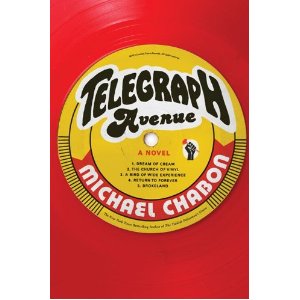
I always enjoy the cover art for Chabon's book.
Groovy book, dude.

Telegraph Avenue—My history with Michael Chabon’s work goes like this: first I read The Yiddish Policeman’s Union (2007), and liked it enough, then I accidentally read part of Gentlemen of the Road (2007), which I did not develop an affinity for, and then I read The Amazing Adventures of Kavalier and Clay (2000), which was really good, just shy of great. I know chronology isn’t on my side here, but from my vantage Chabon is on the upswing, so I’m looking forward to his novel set in the Bay Area, about a white family and a black family, the fathers of which co-own a used record store. My love for music writing is noted elsewhere in this post (see Fear of Music). Excerpt courtesy of the Millions here. (Comes out September 11th 2012.)

This is How You Lose Her—I am aware that I’m in the minority here, but I prefer Junot Díaz’s short story collection, Drown (1996), to his novel, The Brief Wondrous Life of Oscar Wao (2007). Thus, I’m not at all disappointed to see that Díaz is going short for his next project. (Comes out September 11th 2012.)

Fear of Music—Jonathan Lethem’s meditation on the Talking Heads’ album of the same name looks at why we fall in love with certain works of art and New York City in the late 1970’s. (Okay, I know, this one came out on June 1st, but I love a good piece of music writing and I confess to being a Lethem fanboy, so I’m going to sneak this one in.)

Dear Life: Stories—Alice Munro has staked her claim to the title Master of the Short Form, so a new collection by her is officially a bona fide literary event. (Comes out November 13th 2012.)

I've been in a lot of silent cafes before, but none of those experiences have led to published novels somehow...
I'm sad Pamuk isn't naming his books after colors.

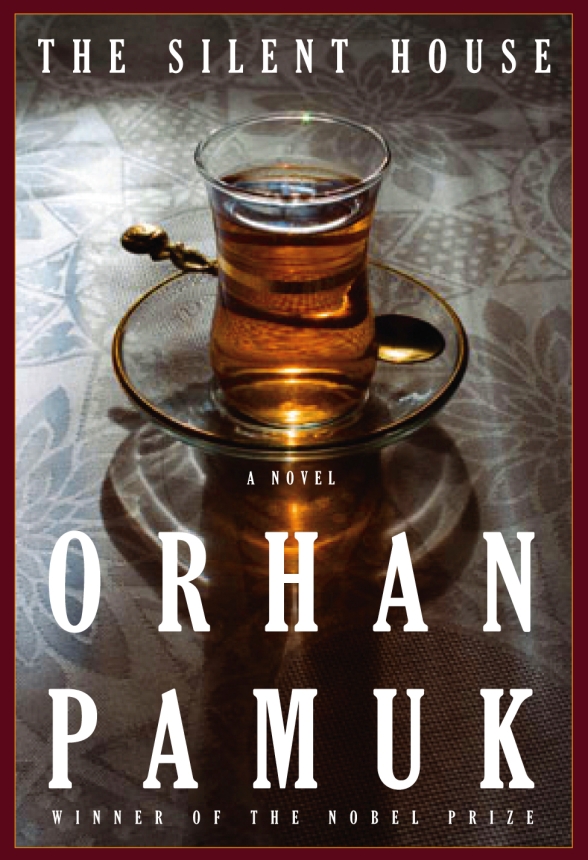
The Silent House—Orhan Pamuk. Nothing I’ve read of Pamuk’s since he won the Nobel Prize in 2006 has been quite as good as those pre-Prize novels, like Snow (2005) and My Name Is Red (2002). This is why I’m excited that this novel, which originally appeared in Turkey in 1983, has finally been translated to English. (Comes out October 9th 2012.)

It’s Fine by Me—Per Petterson. I’ve been making my way through Out Stealing Horses (2007) as of late, and it’s already good enough that I was tickled to hear about the forthcoming release by Graywolf Press of one of Petterson’s earlier novels (it was originally published in Sweden in 1992), about a teenage boy who moves from Olso out into the sticks. (Comes out October 31st 2012.)

Tenth of December: Stories—George Saunders’ stories often make me laugh out loud in bookstores, which attracts the wrong kind of attention from passersby. George Saunders’ soon-to-be-released collection is getting all the right kind of attention, as evidenced by this interview that he did with The New Yorker, and the appearance of the title story of his new collection in that very same magazine. (Comes out January 13th 2013.)

Both Flesh and Not—I can’t say that I’ve read a ton of Foster Wallace’s work, but between the fiction (Girl with Curious Hair, 1989) and the nonfiction (A Supposedly Fun Thing I’ll Never Do Again, 1997) of his that I’ve been through, I prefer the truth to the lies. That’s why I’m looking forward to this new, posthumous collection of essays more so than I did The Pale King (2011). (Comes out October 30th 2012.)

Battleborn—Claire Vaye Watkins. I know Claire and her work from when she was here at OSU, and I can tell you her stories are something worth getting excited over. Here’s an interview she did with One Story about her short “Man-O-War,” and a nonfiction piece she wrote for Granta about her family’s history in Nevada. Oh, and here’s a story she published, also in Granta. (Comes out August 2nd 2012.)

Happy reading, folks, stay safe out there.

Introducing Michael Pecchio: Assistant Online Editor

To help out with the blog posting in these parts, we at The Journal have decided to bring in some new blood: Mr. Michael Pecchio. I met Michael at the OSU MFA Program’s open house, and I can tell you he’s a fine gent, as well as a fiction writer, who comes to us via UC Santa Barbara. I’m proud to present Michael Pecchio, in his own words:

Michael Pecchio

Since I’ll be posting occasionally, as well as working on the blog behind the scenes, I’d like to introduce myself. I’m an incoming Creative Writing MFA student, as well as the new assistant online editor for The Journal.

I’m in a funny position now, a couple months before my move to Columbus, Ohio, for grad school: I serve burgers and bus tables all day in Hollywood, California, and then go home and picture snow storms—what they’re like to drive in, dress for, live with. What it’s like to be unable to wear sandals. What it’s like to use the word storm as a verb (e.g. “You think it’ll storm tonight?”). I saw a YouTube video of people sauntering through the Oval at OSU without sharing looks of astonishment at all the ice falling from the sky, and wondered how I’d fit in.

But, stylistically, I think I’ll settle in well at The Journal. I read with the same eye for clarity and craft that The Journal’s title, for its lack of frills, suggests. Like everyone else here, I will try to see the beautiful and trite in every submission with equal camaraderie. I like reading and talking about literature (especially of the 19th-century Russian variety…sorry English majors), and I’m working on a semi-autobiographical novel-in-stories that I can’t seem to finish. For a little while yet, I live with my cat in Studio City. She says hello, and so do I.

Meet the Editors: Michael Marberry, Incoming Poetry Editor

Today we have an interview with the one and only Mr. Michael Marberry, who is taking over (well, already has taken over, technically) as poetry editor. Michael is a fine southern gentleman, originally from Tennessee, who previously earned his Master’s at the University of Alabama. Without further ado, here are some questions and their answers, in no particular order at all.

ML: What’s your editorial philosophy as poetry editor? Who influenced you and are there any editors out there whom you consider a model for your own endeavors?

Marberry-san, in all his glory.

MM: In terms of editorial philosophy and preference, I’m most interested in stuff that…well…interests me. That sounds ridiculous and a bit cryptic too. But I suppose I’m being intentionally vague there because I want The Journal to be a home for narrative poetry, lyrical poetry, formalist poetry, imagistic poetry, political poetry, fractal poetry, translated poetry, erasure poetry, sound poetry, etc, etc, etc.  I like all those “types” of poetry, and I think the table is big enough for everyone and every brand of poetry to find a seat somewhere, preferably next to someone/something quite different. I really want to publish stuff that I wish I’d written—even the stuff that I know I couldn’t possibly have written. I often ask myself: is this a poem that I want to read again (and again…and again). Does it compel me in some way—emotionally, cognitively, physically? Does it challenge me with something new or something old made new again? Is it surprising and important (whatever that means)?

ML: What are some poetry collections you’ve taken a shine to as of late?

MM: I just recently read a couple poetry collections that I thought were very interesting:  Eduardo Corral’s Slow Lightning and Jorie Graham’s P L A C E. Talk about two different books by two different writers! But I was equally intrigued by what both brought to the table—the way they oscillated between narrative and lyricism, the way they explored ideas, emotions, events, things, etc. in a manner that was, at least to me, exciting and memorable.  (We actually published a couple of Eduardo’s poems in last winter’s issue of The Journal.) A few older collections that I seem to return to often: Major Jackson’s Hoops, Louise Glück’s The Wild Iris, Maurice Manning’s Bucolics, Mary Ruefle’s A Little White Shadow. Those are just a few of the collections that I personally like. Tomorrow, I’ll remember more and kick myself for forgetting to mention them.

ML: When you say that you want every kind of poetry to have a seat at The Journal‘s table, that seems to speak to the fractured nature of the poetry scene right now. I wonder if that element of fractiousness is something you lament, or something you celebrate, or some combination of both.

MM: I think there is some sense of “fracture” in today’s poetry community. People tend to do different things or have different concerns or want to explore different ideas. Often, like-minded people gather together and read and promote and teach and share the work of their peers and/or those “masters” of the genre with whom they feel some sort of creative or ideological kinship. In some sense, I think some fracturing or grouping is unavoidable. As long as we challenge ourselves to also read those whose work differs from our own (e.g. aesthetically, formally, culturally, politically, etc.), I don’t believe that such fracturing need necessarily be a “problem” or something to be feared.  I also don’t believe that “fracturing” is a unique phenomenon to those of us living and writing today. My guess is that the history of poetry (or fiction or non-fiction) is similarly fractured—that, although it may be useful/practical to remember history as being entirely unified or, at its most complicated, simply bifurcated, the history of anything is constituted by innumerable fractures of influence. It’s all excitingly messy.

ML: Good answer—I’m going to steal some of those lines. All right, moving right along, what other lit journals and magazines do you admire?

MM: Some of my personal favorites are Indiana Review, Copper Nickel, Hayden’s Ferry Review, and Sycamore Review. They consistently publish surprising stuff, I think, in each issue—stuff that I like to read multiple times. I’ve got a soft spot for Black Warrior Review because I used to do a little reading work there, and it’s also a really gorgeous publication with a very committed staff. I also admire Nashville Review and The Missouri Review, albeit for different reasons—the former because of their wide scope, publishing lots of different artists across lots of different genres, and the latter because of their depth, publishing multiple poems by only a few poets. But, like I said, there are lots of good journals out there—way too many to name here, in fact.

ML: This is a bit of curve ball, but what do you see as the role of the poet in the contemporary world? To your mind, what function does the poet perform in our technology-driven/dependent, high-speed culture?

MM: I only hope that people are fulfilling their own goals for what their work ought to ideally do and, in turn, constantly challenging themselves to rethink and refine those ideas, techniques, expectations, etc. In terms of The Journal, I always tell people: “Send us what you think is your best work.” And I mean it. The worst thing is when people send something that they think that I’ll think fulfills some role for what a poem “ought to do.” Send us your absolute best work regardless of whatever “role” or “function” you think it’s performing. We want to read it.

ML: To wrap this up and put a bow on it, what are your plans for the summer? What/who do you plan on reading?

MM: My summer plans are still largely to-be-determined. I’m hoping to travel a little bit to Tennessee and Michigan. I’ve got to do some preparation for the fantasy-football league that I do with my buddies back home each year. I just bought some books that I’m hoping to read—a short-story collection by Gabriel García Márquez and another by Roald Dahl. I’ll be watching lots of summer blockbusters. I’ll be working with some talented, local high-school students at OSU’s Young Writers Workshop. I’ll be revising my thesis and studying for GRE tests. And so on. I’ll probably drink a lot of iced coffee and Bell’s Oberon (but not at the same time).

To see some of Michael’s editorial work, all you need to do is crack the poetry pages of a recent edition of The Journal (he was helping out Tory last year). I want to thank him for sitting down with me for this interview, and thank all of you for reading. Until next time.

Meet the Editors: Nick White, Incoming Fiction Editor

One thing I’m going to endeavor to do in this space is to introduce you to some of the other drifters here at The Journal, especially our genre editors. Joining us for an interview today is Nick White, our incoming fiction editor who will start shaping the pages we dedicate to the liar’s art in our magazine in the fall.

ML: Just to tie this up with my last post, let’s say the Pulitzer Board called you one evening a month or so ago. “Nick,” the head of the board says, “Listen, we’re completely lost on this whole fiction thing. Don’t worry about who the finalists were. What should we pick?” What would you tell our distressed friend?

NW: It’s been a great year for fiction, so I think the decision to not award a prize can be a bit misleading. For my money, I was hoping Edith Pearlman’s Binocular Vision might be considered. Her collection has already won the National Book Critics’ Circle Award and was nominated for the National Book Award. I think she’s a wonderful American voice. Her stories seem to be about the very things critics say American writers shy away from. There’s been talk for a long time that American writers are too insular, that our stories and novels are too provincial. Ms. Pearlman’s stories are anything but. For instance, her story “Vaquita” centers around a female prime minister of a South American country embroiled in a revolution of sorts. The story was brilliant and sad and very different from some of the writing I am seeing from others. Winning the Pulitzer, I think, would have brought her more readers. Also, I really enjoyed Julie Otsuka’s novella The Buddha in the Attic, a searing portrait of Japanese picture brides who come to the United States soon after the turn of the century and endure hardship, racism, and sexism up until the time they are sent away, with their husbands and children, to concentration camps in California after the attack on Pearl Harbor. It was told from a first-person plural point of view—the “we” voice—and I thought it was really well done; parts of it read like poetry.

ML: Well, staying in the vein, who’s your favorite living author who doesn’t write in the king’s?

NW: Probably Marquez, if I had to choose. One Hundred Years of Solitude is one of my all-time favorite novels: the scope, the language! It’s a beautiful read. Also, enjoyed Love in the Time of Cholera, a decadent romance that didn’t translate so well to the big screen. I am also a fan of his short fiction and plan to teach “A Very Old Man with Enormous Wings” to my creative writing class this summer.

ML: So what’s on your nightstand now?

NW: I’m reading four books at once. It’s kind of crazy. I have a problem, I think. I’m reading Roth’s The Human Stain, because I think his Zuckerman novels will help me with my thesis, which also deals with a writer. Though I hadn’t read much by her, I am just finishing up Anne Tyler’s The Amateur Marriage, which, sentence by sentence, has blown me away. I’m also about halfway through Tobias Wolff’s Old School. And I’m mixing it up a bit by reading a biography of Eudora Welty. Reading about her love life gives me hope.

ML: I know you worked with Michael Kardos on Jabberwock Review. What were some lessons you took from that experience?

NW: One thing I took from Mike, just in general, is the idea of being an open-minded reader, and to not impose my own aesthetic onto a story. So when I approach a story, as difficult as it may be, I try to look at it and let it tell me what its goals are and see if the story is meeting the goals it’s set for itself. Jane Smiley has this wonderful book called Thirteen Ways of Looking at the Novel, and she says she doesn’t think of fiction as good or bad, but looks at it in terms of the worlds it invites you into, and whether or not it’s successful at rendering those worlds. So I’ve learned not to be closed off to a particular style, whether it be hard-nosed realism or something more speculative. For the issues of The Journal that we’re going to try to craft I want it to be very diverse.

ML: If you have one, what’s your editorial creed?

NW: Martin Luther, and this is going way back, said to sin boldly, and if I have one creed it’s that I want the stories I read to sin boldly. To have a confident voice, to not be apologetic, but to be bold. I want strong voices.

ML: What’s coming out of your pen these days?

NW: I’m working on a cycle of stories about a Southern writer from the Mississippi Delta, down and out on his luck. I’m working on one of them now about his time as a librarian in Oxford, MS. That place has a very specific writer culture that I am trying to capture.

ML: Is that a locale where you’ve spent a lot of time?

NW: Well, I have a complicated relationship with Oxford because I earned my Master’s from Mississippi State, which is the arch-rival of Ole Miss. But some of the grad students and I would always go up to Oxford to use their library—they have a wonderful facility. It’s such a literary town, too, and when you think of Mississippi in the zeitgeist you don’t necessarily think of it as being literary, which is a shame, but Oxford has a certain panache to it because they have Faulkner’s home and he’s buried there, and it was also the home of Barry Hannah—the great Southern writer—before he passed. It’s a place that inspired me, as I’m sure it did many writers from that region. Authors always stop by to promote their books because there’s a great bookstore there called Square Books. The story I’m writing now deals with a bookstore too, though only in a minor way—it becomes the backdrop for a disastrous love affair my narrator becomes entangled in.

ML: Setting aside the fact that we want our readers to go through our issues cover to cover, if you had to choose one thing our loyal subscribers should read from the most recent print issue, what would it be?

NW: “Abu Grave.” I love that story. I found it in the slush and thought it was just hilarious—it was really funny in a horrific way. Also the novel selection “Out of Illiana” was great. One of our readers, Brett Beach, found us that gem.

ML: In this past year, 2011, who was the best new writer you discovered?

NW: New to me or new to the scene?

ML: Either or.

NW: New to the scene would probably be Kevin Wilson, who wrote The Family Fang. New to me, I would say Edith Pearlman. She had three books out by small presses, but she’s new to me and she just blew me away. Also, Ethan Rutherford. He doesn’t have a collection out, but I’ve read a couple stories by him now: “Summer Boys,” which was put out by One Story, and “The Peripatetic Coffin” which was in The Best American Short Stories 2009. He writes really interesting work that is just very different from anything else.

ML: All right, to take it home, what are you doing for the summer, and what are you planning on reading?

NW: I’m teaching that creative writing class, where we’re going to be reading a lot of speculative fiction. I’ll also be making my way through Phillip Roth, and some more Ann Tyler. Probably the next thing I’ll read will be Dinner at the Homesick Restaurant. Maybe some more Jane Smiley too, I met her at AWP and she was just wonderful.

I want to thank Nick for sitting down with me. We’ll all be seeing him in the pages of The Journal next fall. Until then.

CONTEST DEADLINE EXTENDED to MAY 15th

The Journal is proud to announce our first ever contest in fiction, nonfiction and poetry. A $500 dollar prize will be awarded in each genre, and the winners will appear in the Winter 2013 issue of The Journal. All entries will be considered for publication in The Journal.  Each contest-submission should include 1-5 poems.  One story or essay per submission.  There is no word limit for fiction and nonfiction.  Multiple submissions are permitted for the contest; however, each additional submission must be accompanied by a new contest-fee  Entry fee is $15 dollars and includes a one-year subscription to The Journal. Please go to submishmash to submit. Entry deadline is May 15th.


Fiction Judge, Christopher Coake

Christopher Coake, a native Hoosier, received his MA in creative writing from Miami University of Ohio and his MFA in fiction from Ohio State University. His short fiction has appeared in journals such as The Gettysburg ReviewThe Southern ReviewEpoch, and Five Points, and has been anthologized in The Best American Mystery Stories 2004. His first book, a collection of short stories titled We’re in Trouble, was released in 2005 by Harcourt. His new novel, You Came Back, will be published in Spring 2012 by Grand Central.


Nonfiction Judge, Sonya Huber


Sonya Huber is the author of two books of creative nonfiction, Cover Me: A Health Insurance Memoir (2010), finalist for the ForeWard Book of the Year, and Opa Nobody(2008), shortlisted for the Saroyan Prize. She has also written a textbook, The Backwards Research Guide for Writers: Using Your Life for Reflection, Connection, and Inspiration(2011). She teaches at Fairfield University.


Poetry Judge, G.C. Waldrep

G.C. Waldrep’s most recent collections are Archicembalo (Tupelo, 2009), winner of theDorset Prize, and Your Father on the Train of Ghosts (BOA Editions, 2011), a collaboration with John Gallaher, as well as a chapbook, “St. Laszlo Hotel,” from Projective Industries.  Other recent work appears in recent or forthcoming issues of Boston Review, Crazyhorse, Colorado Review, Threepenny Review, Boulevard, The Nation, Harper’s, New American Writing, and Best American Poetry 2010. A past National Endowment for the Arts Fellow in Literature, Waldrep lives in Lewisburg, Pa., where he teaches at Bucknell University, edits the journal West Branch, and serves as Editor-at-Large for The Kenyon Review.


Pulitzer Perturbations

Well, obligatory Pulitzer post, we meet at last. Let’s begin by allowing that people smarter than I have already cleared a good deal of the dust that the Pulitzer Prize Board kicked up with its decision not to single out a tome of the fictional variety (my thoughts are perhaps best captured by better minds here and here, and to a lesser extent here). What I have to say regarding this hoopla—what I indent by way of contribution to this debate—is that, at the end of it, I pitch my tent with the camp that thinks this more cause for concern than anger.

Most card-holding members of the club who write on things of this nature agree that there are only two real explanations for the board’s decision not to pick a winner: either they were too conflicted over the finalists to agree on one book, or there wasn’t enough enthusiasm for any of the nominees to put them over the top. It is distinctly the latter, not the former, that worries me.

You see, while it hurts to see the literary world I love so dear losing precious sales, and to watch the likes of Denis Johnson, Karen Russell, and David Foster Wallace—all authors whose work I’ll carry with me to the grave—get the nose-thumbing treatment, what keeps me up in the wee hours is not that idea that the board was so passionately at odds over the likes of Train Dreams, Swamplandia!, and The Pale King, that they couldn’t pick a winner, but that they took a look at these three volumes and decided none of them could bear the weight of the prize. What troubles me is the notion that what the literary world thinks of as good (and all three of these works reared their heads on enough critics’ end-of-year lists to meet that criteria), has gotten so far away from what the reading public, as represented by Pulitzer & Co., is looking for, that the two can no longer even hold hands and pretend to smile for the camera at the family reunion once a year. I’ve said it before and I’ll say it again: the thing that worries me more than e-readers, and SparkNotes, and cell-phone literature, and revised editions of Adventures of Huckleberry Finn, and a shrinking literary market, and decreasing book sales, is the idea that the literary world and the public are growing estranged from one another. The thought that what is said in our literature won’t echo through our culture, or that what happens in our culture won’t find it’s way into our books, is downright disturbing to me.

Issue 36.2 Is Now Live!

We are proud to announce that issue 36.2, our special poetry issue, is now live. In this issue we have some great poetry and art, and for the first time you can listen to selected poets read their work. Check out Christina Veladota read her poem “A Brief Novel at the End of July”.

General Submissions Closed Until June 1st (Contest Submissions Remain Open)

General submissions to The Journal will be closed until June 1st.  We apologize for the inconvenience, but we hope this brief break in accepting submissions will allow us to reduce the backlog and provide faster response times in the future.

Contest submissions remain open.

The Journal is proud to announce our first ever contest in fiction, nonfiction and poetry. A $500 dollar prize will be awarded in each genre, and the winners will appear in the Winter 2013 issue of The Journal. All entries will be considered for publication in The Journal.  Each contest-submission should include 1-5 poems.  One story or essay per submission.  There is no word limit for fiction and nonfiction.  Multiple submissions are permitted for the contest; however, each additional submission must be accompanied by a new contest-fee  Entry fee is $15 dollars and includes a one-year subscription to The Journal. Please go to submishmash to submit. Entry deadline is May 1st.


-the editors

Just the Facts

Let me kick this off by saying I am a layman when it comes to the wild frontier of nonfiction—I’ve taken classes on the subject and have written a few essays, but I am still fresh to this territory. Other things I am not, include a troublemaker and a mouthpiece for editorial views of The Journal. But what I aspire to be in the following lines is someone raising a reasoned but passionate objection to something I heard the other day, from a man I have a lot of respect for: Mr. Ira Glass. I’m a big fan of This American Life, and of Mr. Glass in particular, and on the whole, in this dust up with Mr. Mike Daisey, I agree with Ira; Daisey submitted a segment of this theatrical piece The Agony and the Ecstasy of Steve Jobs to TAL as a piece of journalism when it was clearly not up to journalistic standards. After the fact, Mr. Glass appropriately admonished Mr. Daisey for this in a very public fashion, and he was in the right in this instance. Agreed.

Where I begin to object comes at the point in the conversation between our two misters, when Daisey, having admitted his mistake in submitting his piece to TAL, defends the work as a piece of theater (all quotes from TAL are taken from the transcript of “Retraction,” which is available on their website).

Mike Daisey: My mistake, the mistake that I truly regret is that I had it on your show as journalism and it’s not journalism. It’s theater. I use the tools of theater and memoir to achieve its dramatic arc and of that arc and of that work I am very proud because I think it made you care, Ira, and I think it made you want to delve. And my hope is that it makes—has made—other people delve.

Ira Glass: Right but you’re saying that the only way you can get through emotionally to people is to mess around with the facts, but that isn’t so.

Mike Daisey: I’m not saying that’s the only way to get through to people emotionally. I’m just saying that this piece, in how it was built for the theater, follows those rules. I’m not saying it’s the only way to do things.

Well, if they’re not going to say it, I am. The fact is, there are techniques that memoirists, personal essayists, and literary journalists employ that “mess around with the facts” to “get through” to people. The most obvious of these is dialogue. From fiction we know that having characters talk helps make an audience care about them, and that technique has been imported into creative nonfiction. While quotes need to be precisely recorded in journalism, it is understood that dialogue in creative nonfiction is re-created, though we trust the author to attempt to be true to the spirit of the comments. This is especially relevant to Daisey’s case, as he was quoting dialogue that was translated from Chinese, a language that neither he nor Glass speak. Since TAL wasn’t provided with recordings of the conversations that occurred in Shenzhen, Glass must have known that every time conversation was presented it was a re-creation, which would require a level of fabrication, though in a way that attempted to hew close to reality. Right there it seems to me, you have an element of the story that falls short of journalistic standards. (As it turns out, the dialogue between Daisey and a supposedly thirteen-year-old Chinese Foxconn employee, was one of the elements of the story that was later disputed—he says it happened, but his translator has no recollection of this).

Writers of creative nonfiction have other, more substantial means of muddying the waters of factuality—combining elements of multiple people into a single character or finding ways to reorder the timing of events (not necessarily fudging the dates, but using literary techniques like flashback or prolepsis to present events next to each other that did not actually occur as such)—and are not always hauled into the stockade for committing these acts in the service of a narrative. Annie Dillard famously invented a cat in Pilgrim at Tinker Creek, and yet she has not yet been stood up in front of the firing squad for it.

And the reality is that teachers of creative nonfiction encourage the use of these techniques, while admitting the gray area they create. Bill Roorbach, who was a teacher in the MFA Program at the Ohio State University for many years, wrote The Art of Truth, a wonderful creative nonfiction textbook that has been recommended to me in workshops here at OSU.

What the writer of nonfiction has is paper and a system of runny inked markings that somehow she is supposed to turn into a representation of reality that people will call true. But the marks on the page are never the reality they evoke or attempt to evoke, and never can be. A page of words is not your father, no matter how carefully those words are arranged to approximate him. A column of numbers is not last night’s baseball game. Only the game itself is the game, and the game is history, gone forever, irretrievably gone…

All writers of nonfiction use every tool at their disposal—voice, language, drama, passion, characters, literary talent—and every scrap of learning, to make their marks on paper create something in their readers’ minds that approximates experience, whether that experience be the writer’s father [or] a baseball game… (2)

But in the case of Daisey v.  Glass, trust is perhaps most important.

Readers do expect the writer to be true to something… Good faith is the key. And part of that faith is trust in a readerly understanding of the differing rules and traditions and emphases of the subgenres under the wide and inclusive and elegant rubric of creative nonfiction (Roorbach 6).

At the end of it, Mr. Daisey violated Mr. Glass’s trust, and the trust of TAL listeners (I can’t speak for his theatrical show as I’ve never been, and don’t know what, if any prefaces he gives in that realm). The degree to which Mr. Daisey fabricates and alters details, encounters, and even whole characters, does not fall into the gray, but is beyond the pale. So in this case, I agree with Mr. Glass. But there is something he says toward the end of the “Retraction” episode of that makes me squeamish:

Ira Glass: Are you going to change the way that you label this in the theater, so that the audience in the theater knows that this isn’t strictly speaking a work of truth but in fact what they’re seeing really is a work of fiction that has some true elements in it.

Mike Daisey: I don’t think that label covers the totality of what it is.

Ira Glass: That label—fiction?

Mike Daisey: Yeah. We have different worldviews on some of these things. I agree with you truth is really important.

Ira Glass: I know but I feel like I have the normal worldview. The normal worldview is somebody stands on stage and says ‘this happened to me,’ I think it happened to them, unless it’s clearly labeled as ‘here’s a work of fiction.’

There is a black-or-white tone to Mr. Glass’ statements, that suggest that there isn’t a gray area here: it either all happened, as stated, or it’s a work of fiction. It’s the “strictly speaking” part of this that hangs me up, because there is some gray in creative nonfiction. I’m fine with the fact that Mr. Daisey included dialogue in his work, speaks as if he’s been in dorm rooms he has only seen from the outside, and guesses high on the number of workers he’d interviewed (since he says he doesn’t remember the exact number). And—this is where I’ll commit what some see as a mortal sin—if it made for a better narrative, I’d prefer to get the story that way, so long as he cleaved to the essential truths (not the facts) of his work. But Mr. Daisey went much further than this, and deviated from the facts in ways that actually seemed to twist the truth, and because of this I believe Mr. Glass is right to be upset. Again, Roorbach provides a clarifying gloss:

[V]erifiable accuracy is not one of the primary values of creative nonfiction, as it must be for traditional journalism or science. Verifiable accuracy is an important value in creative nonfiction, but sometimes, especially in personal essays, it must hold the door for the greater values of drama and character, and the peculiar artistic force of memory, and let them enter the ballroom first. And here we do run into ethics, which are as individual as voice. I believe that an overinsistence (as opposed to a reasonable insistence) on verifiable accuracy has about the same deadening effect on art as an overinsistence on conformity in style or subject. What’s verifiable isn’t always what’s true, and the writer of creative nonfiction will always err on the side of truth over facts. When verifiable accuracy takes over as the primary value in a piece of writing, we are moving away from creative nonfiction and back toward traditional journalism.

But the mores of writer of nonfiction are crucial to the trust of readers. A reader has a right to expect that what is represented as true and accurate is true and accurate (5).

This is where I am reminded of the John D’Agata hoopla, which has only just subsided. Now, I’m not a D’Agata apologist, nor am I here to re-herd any of the cat’s let loose in that discussion. But what I am reminded of is one of the most calm, well-reasoned, and insightful things I read during of all that (of which the tone of this post has been a pale and well-meaning imitation), that came from Dinty W. Moore:

Do I want a world where genre distinctions, the place of the essay in the nonfiction spectrum, and the role of artistry in nonfiction writing can be debated? Yes, I most certainly do.

But I am distressed by how John D’Agata is raising the question, by his seeming disrespect for the rest of us, his dismissal of legitimate concerns and questions, by the fact that even his discussion with the fact-checker turns out later to have been fabricated, and by his idea that art has to “trick” us (Moore).

To my eyes, the crux of that first paragraph is the word debate. And debate, is exactly what fails to happen when those who stick to old-school journalistic standards import those standards wholesale to the realm of creative nonfiction, or when it is suggested that a thorough enough fact checker (or an author who performs this function him or herself) could make the interesting and difficult questions surrounding creative nonfiction magically disappear. What the field of creative nonfiction needs—and journalists should have a voice in this, as an awful lot of them wind up writing creative nonfiction and controlling the outlets where it gets published—isn’t hard-and-fast rules, but a discussion about what is appropriate in what contexts. Since I have leaned so heavily on him until this point, I see no reason not to let Bill carry us off into the sunset.

Writers with a journalistic leaning will never be comfortable with memoirists… Memoirists will never be comfortable with science writers… Essayists will always disdain mere reporters of experience. But they are all laboring in the same salt mine, their divisions no deeper than those between formal poets and writers of free verse, which are deep enough (Roorbach 3).

Opposing camps are just camps no matter what weapons they pull out and no matter what casualties they cause or take; when it comes to literary genres, most wars turn out to be civil wars (Roobach 3).

Links Roundup, March 2012 Edition

Here are some links from the literary world that I’ve stumbled across and thought you all might be interested in. The annual AWP conference happened a little over a week ago in Chicago, and since then I’ve been turning over in my head what I heard, saw and read there.

The most interesting panel I went to looked at new directions in short fiction, and featured the fascinating combination of Steve Yarbrough and Todd James Peirce, among others eloquents. The thesis of the confab, if there was one, seemed to be that research-based fiction, in the vein of Jim Shepard, and darkly funny stories, like those of George Saunders, are making a comeback. I happened to have read some of Shepard’s latest collection You Think That’s Bad in the car ride on the way to Chicago, and had been quite entertained by it, and that same day I came across this interview with Shepard where he discusses some of his research techniques, and how he goes about writing characters that hail from cultural and ethnic backgrounds different than his own.

One of my best purchases at AWP (right behind that Lou Malnati’s deep dish) was Mid-American Review editor Michael Czyzniejewski’s book of 40 short-shorts, Chicago Stories. Each yarn is told from the persona of a famous Chicagoan, and a preview of the collection, from Curbside Splendor, is available here.

Also from the front lines of AWP, a video of a panel about what nonfiction editors are seeking when they sort through the slush pile. Our own Silas Hansen discussed some of the things he looks for when going through nonfiction submissions in a recent post featured on this here blog, so if you’re thinking of sending in your essay, check those out.

The one-year anniversary of the 2011 Great Tohoku Earthquake and Tsunami was just observed, and we’re starting to see some literature that attempts to deal with the disaster. Tomo is a collection of fiction and essays that aims to bring Japan stories to young adult readers; all proceeds of the book will go to organizations that assist teens in the tsunami-affected areas. The Japan Times looks at 2:46—Aftershocks: Stories from Japan’s Earthquake, which was originally conceived on Twitter by a British teacher living in Japan, then written by an online community over a period of seven days in order “to tell people’s stories while their feelings were raw, memories fresh and futures so uncertain.”

That’s all for now folks. If you have any links you think I should know about, please email me at thejournalmag@gmail.com, and just make sure you mention my name in the subject line.

Live from AWP: Silas Hansen, Associate Nonfiction Editor

The staff of The Journal is in Chicago right now at the annual AWP conference. For those of you who haven’t been before, take my word for it: it’s overwhelming. That’s why this post isn’t about what I originally planned—I was going to tell you about what I learned at the panels I wanted to attend this morning, but I made the mistake of going into the bookfair at 9AM and got distracted. Four hours later, I was still wandering around, taking turns covering our table (we’re at G12—stop by and see us!), and meeting up with old friends.

While I’m disappointed that I lost track of time and missed not one but two panels with one of my favorite writers (Cheryl Strayed), I learned a lot from walking around and talking to editors of other magazines. I spent a while talking to some other nonfiction editors and writers and everyone kept asking me the same thing: “What do you look for in an essay? What’s your ‘dream’ submission?”

It’s something I’ve been thinking about a lot lately, since I joined the editorial board of The Journal last spring, then took Michelle Herman’s literary publishing class this autumn. I’m sure everyone can remember telling someone, “You should read this book. It’s amazing,” and then being unable to explain why when pressed for more. I felt like that every time someone asked what I look for when I’m reading submissions.

I can tell you what I constantly look for: memoirs that deal with subjects completely unlike my own life (one of my favorites is Natalie Kusz’s Road Song, which is about her life after her family moved from their suburban California home to Alaska when she was six; I grew up in a home with more television sets than people, and I love that she shows me a world I otherwise never would have known) and nonfiction that deals with subjects I’m interested in (politics, current events, gender and sexuality, race and ethnicity, lives of working-class Americans). I gravitate toward memoir and immersion journalism. I value honesty in writers—though that’s a post for another time.

When I sit down to read submissions for The Journal, though, I try to suspend those judgments and look for other things, things that anyone can appreciate, regardless of their interest level in the subject matter. I want readers of The Journal to read something and, even if they don’t love it as much as I do, understand why I found it valuable. So here are the three things I look for in every piece of writing.

1) Beautiful language. I want the language to be as precise and clear as possible, but I don’t want it to be plain. I don’t want to have to stop and think about what the writer really meant at every paragraph break, but I do want to stop from time to time and think, “Wow.” I want the words to be juxtaposed in such a way that it is surprising, yet true.

2) A narrator who makes me think about something I haven’t thought about before, or who makes me think about something old in new ways. I sometimes hear people say, “I never want to read another essay about _____,” and while it’s true that I sometimes roll my eyes when I see writers doing the same story over and over, I love reading an essay when I know what’s going to happen but I end up surprised anyway. Put a twist on something that’s been done to death. Make me interested in yet another grief/loss/addiction/parenthood memoir because you have something to say that hasn’t been said before.

3) Structure that works with the content for a greater reading experience. I used to be anti-experimentation, and I still enjoy reading traditional narrative essays, but recently I’ve started to see the ways that experimenting with form can enhance the reading experience. I get annoyed when people value experimentation over all else, so that’s not what I’m saying at all—instead, I want to know that the writer thought about the structure of the essay and chose the best option for their piece. I don’t ever want to think that they chose a lyric structure because they weren’t sure how to handle narrative, or that they chose a narrative structure because they didn’t know that they had other options. In the end, I want the structure to help the essay without calling attention to itself.

I know you’d probably rather hear me say that I want to see a 2500 word lyric essay about traveling to a foreign country—something specific that would help you send me exactly what I’m looking for. But the truth is, I don’t always know what I’m looking for until I read it and think, “Wow, this is it.”

The Year in Reading: The Journal Staff’s Favorite Books of 2011

I am an admitted fan of lists, all reasonable objections to them be damned. Since the staff of The Journal has returned to the mother ship from their far-flung holiday destinations, I’ve been polling them as to what were the best works they read in the past year. I made no bones about genre (as in poetry, fiction, non-fiction), genre (as in sci-fi, mystery, etc) or date of publication—as long as it was read in the year 2011. Needless to say I’ve had to edit piles of adult content out of the responses, but below I’ve listed what remained from that winnowing. Enjoy!


Nick McRae, Poetry Review Editor: Unholy Sonnets, Mark Jarman

“The best book I read in 2011 was Mark Jarman’s collection, published in 2000. I’d read many of the sonnets in other venues, but I’d never sat down with the full collection until this past year. The poems are beautiful and were exactly what I needed at that moment, as I had myself recently begun working on a group of sonnets dealing with Christian mythology and spirituality. Jarman’s book helped me think about the subject from an angle I hadn’t considered. It has had a huge impact on my writing already.”


Dominic Russ, Fiction and Nonfiction Review Editor: Suttree, Cormac McCarthy

“Often conceptualized as the intersection between the “Nighttown” of Ulysses and the picaresque meanderings of other river narratives such as The Adventures of Huckleberry Finn, Suttree, which took Cormac McCarthy thirty years to write, blends high narrative, artifice, and verbosity with the sundry world of the booze hounds and grifters that haunted the dregs of Knoxville in the early 1950s. As brooding and dark as it is funny, McCarthy’s prose strips the natural world of any romanticism, allowing the reader to perceive the earth in its brutal and unblemished abundance.”


Alex Fabrizio, Production Manager: Ulysses, James Joyce

“I’d never read it before the brilliant summer class offered at Ohio State, which was taught by the brilliant Sebastian Knowles, and I’m so glad—what a way to get introduced to this hilarious, bizarre, and ingenius piece of writing.”


Daniel Carter, Design Editor/Web Developer: Magic for Beginners, Kelly Link

“Strangely, one of the most memorable books I picked up this year is something I’ve read at least a few times before. I don’t even love all those stories in it that much, but the title story is one of those things that seems able to be disturbingly relevant to whatever year or life situation you’re in. I look forward to reading it again in 2015.”


Michael Marberry, Associate Poetry Editor: Ray, Barry Hannah; The Wild Iris, Louise Gluck

Mr. Marberry didn’t give rationales for his picks, but I’ve heard tell he doesn’t read any fiction by writers born north of Tennessee/Alabama border, so Barry Hannah makes sense. Marberry’s second pick is a collection of poetry by Louise Gluck from 1993, a wonderful poet who even a laymen like me has had chance to read—I expect her new collection lives up to the rest of her work.


Silas Hansen, Associate Nonfiction Editor: Salvation on Sand Mountain, Dennis Covington

“Covington’s book was published way back in 1995, but is still one of the best examples of immersion journalism/narrative nonfiction I’ve found. I love how he shows such compassion for the people in the book—snake handlers in Southern Appalachia—and paints them in such complex and interesting ways. He never takes the easy way out, and I was drawn in by his prose from page 1. Great book, even if you think you’re not the least bit interested in the subject.”


Nick White, Associate Fiction Editor: The Aspern Papers, Henry James; The Ghost Writer, Phillip Roth

“Written over a century ago, James’s novella is practically perfect in every way. Immensely readable, the story centers around a literary critic’s attempt to woo two old spinsters in the hope to obtain rare letters penned by a poet he admires. James is a master of scene and detail.

“Like The Aspern Papers, The Ghost Writer is an oldy but a goody. If you are a writer (or like to think, like me, that you will one day grow up to become one), this book will fascinate. Roth is a master, and I will read anything that he writes; in fact, reading this book has inspired me to go through the whole Zuckerman series.”


Tory Adkisson, Poetry Editor: Rookery, Traci Brimball; Beautiful in the Mouth, Keetje Kuipers

“I read many books in 2011, so many that my best book is actually a tie between two dazzling debut poetry collections. Both poets write about the erotic in ways that make me insanely jealous—their figuration is masterful, their intelligence measured, their attitudes replete with a sultry swagger that’s otherwise difficult to define. Kuipers may be more a poet of place—her Oregon, New York, Montana, and everywhere else are each imbued with an incredible, lived-in sensual depth, while Brimhall is a poet of mythic consciousness—just check out her poem in the voice of Odysseus’s maids cleaning up the carnage of his battle with Penelope’s suitors! Both books left indelible impressions on me, and gave me models of what to strive for as I am just starting to work on a draft of my first book.”


Alex Streiff, Fiction Editor: Disgrace, J.M. Coetzee and Tsim Tsum, Sabrina Orah Mark

“I remember after reading the first page of Disgrace while still in the bookstore, I stopped and said, probably a bit too loudly: ‘This is a fucking writer.’

Tsim Tsum is breathtaking in it’s ability to mix the humorous and the beautiful.  It’s a profoundly fun read.”


I’ve mentioned elsewhere that my favorite book of 2011 was Tea Oberht’s The Tiger’s Wife, but I expect I’ve already flapped my gums too much about that novel—she doesn’t need the extra sales at this point.

Well there you have it ladies and gentlemen. We here at The Journal will get our noses back in the books where they belong, and we’ll see you back here in a year or so. Sound good?

Changes at the Journal’s Blog

Since the Journal came online in early 2011, this space has been a repository for news and announcements about the magazine – and in that role it has served us handsomely. Starting in December though, I’m excited to be able to say that there are going to be some changes round these parts. While announcements about contests, submissions, and other such business will continue to appear here, so will more blog-like content by myself and other members of the Journal’s staff.

Perhaps, before I go any further, I should take a moment to introduce myself. My name is Michael Larson, but since we’re going to be friends you all can call me Mike, and I’m the online editor of the Journal. A second-year MFA student in fiction, I hail from the boondocks of Washington State (Rainier, population 1,794 as of the 2010 census, for anyone who wants to know), though I arrived in Columbus via a teaching stint in Northern Japan.

While I have no illusions about the world’s need for another literary blog (I just recently figured out that D.G. Myers, who writes Commentary’s literary blog – the thought-provoking Literary Commentary – works within a mile of the Journal’s offices), I think we can use this space to keep our readers updated about the literary goings-on in Columbus, as well as the book-related thoughts, opinions and appetites of the Journal’s staff. Actual prose, poetry and reviews will continue to appear in the other parts of the website, and in the print magazine, but here you can expect to see our thoughts on the books of the day, trends in literature, and whatever else we just can’t stand to keep quiet about. Almost all of it will be book-related, and hopefully all of it will be of interest to you. Saddle up, we’ll be pulling out of the station directly.