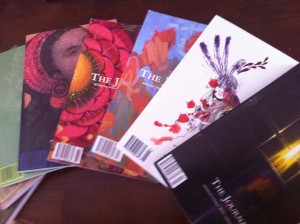
Announcing the winner of The Journal‘s annual fiction contest

The Journal is proud to announce the winner of the 2011 fiction contest, “The True Story of the Romanian Dog Boy” by Christopher Mohar.

Lee K. Abbott, judge of the contest, says of “The True Story of the Romanian Dog Boy”:

If you like, as I betimes do, to link arms with the literary Lou Reed for a walk on story’s wild side, then welcome to Paradise as imagined by Christopher Mohar channeling Dali, Bosch, and P. T. Barnum, a place made cockeyed by want and rue. Here’s a story, folks, about the tribe gone crooked, where love is as freaky as it is felicitous, where the engine of narrative does not clank or blow a fuse or sputter to a stop, where the aesthetic risks are as huge as its rewards. No effete ruby slippers, friends. No Woolworth magic wands. Just writing at the cliff’s edge and for keeps.

Christopher Mohar is the recipient of a Carol Houck Smith Fellowship from the University of Wisconsin and The Southwest Review’s McGinnis Ritchie Award for Fiction. Christopher has taught writing at two UWs (Seattle and Madison) and in a men’s correctional facility, and in past lives has been a metallurgical engineer, a busboy, and a legal assistant’s assistant. Some of his recent and forthcoming work can be found in Creative Nonfiction, Lit, Gastronomica, and New Stories from the Midwest – 2011 (Indiana University Press).

From the story:

The lobby. To your left you’ll see the exploded animatronic baboon with its latex face-skin flipped inside-out and fur suit unstrapped, and me buried to my elbows in tubes and cylinders. To your right, Bob has taken over the register after telling me to give the baboon a “total overhaul,” like I’m some kind of mechanic. That’s how I almost miss her, though I’m waiting.

For the third day in a row, she comes in like a payout on the penny slots, $12.99 dumped to the counter one handful after another. She doesn’t wait for Bob to count it before disappearing through the entryway. I glimpse small breasts, straight hips, a birthmark down her neck with the texture of crystallized honey. If I were Romulus, she’d be the she-wolf to suckle me to safety. If I were a bear-boy, I’d feed on her.

Look for “The True Story of the Romanian Dog Boy” in the Summer 2012 issue of The Journal.

Cheers,
The Editors

Pushcart Nominees

The Journal is proud to announce the nominations for this year’s Pushcart Prize.

Fiction
Jessica Hollander, “What Became of What She Had Made” (35.1)
Alexander Lumans, “The American Indian is Dead” (35.1)

Poetry
Laurie Blauner, “Nature Poem without Nature” (35.2)
Alex Dimitrov, “A Second Heart Swims Up My Throat” (35.1)
Louisa Diodato, “Hive” (35.2)
Christopher Salerno, “Halloween” (35.1)

Please join us in congratulating our nominees!

Only A Few Days Left for The Journal/OSU Press Wheeler Poetry Prize Submissions

The OSU Press is now accepting entries for the yearly Wheeler Prize in Poetry. Manuscripts must be sent during the month of September and include a $25 dollar handling fee. All entrants will receive a one-year subscription to The Journal. We are also excited to announce that this year’s judge will be Andrew Hudgins.

Cheers,
The Editors

From the OSU Press:

The Journal, the literary magazine of The Ohio State University, selects one full-length manuscript of poetry each year for publication by The Ohio State University Press. In addition to publication under a standard book contract, the winning author receives the Charles B. Wheeler prize of $3,000.

Entries of at least 48 typed pages of original poetry must be postmarked during the month of September. Entries postmarked later than September 30 will be returned unread. Clear photocopies are acceptable. Your name or other identification should only appear on the cover page.

Manuscripts must be previously unpublished. Some or all of the poems in the collection may have appeared in periodicals, chapbooks, or anthologies, but these must be identified.

Include a nonrefundable handling fee of $25.00 (U.S. dollars) with each manuscript (check or money order payable to The Ohio State University). Entrants will receive a one-year subscription (two issues) to The Journal.

Include a stamped, self-addressed business-sized envelope so we can notify you of the results. Manuscripts will not be returned.

If you wish us to confirm receipt of your manuscript, include a stamped, self-addressed postcard. The winning entry will be announced by the following January 15.

OSU Press assumes no responsibility for lost or damaged manuscripts.

Mail to:
Poetry Editor
The Ohio State University Press
180 Pressey Hall
1070 Carmack Road
Columbus OH 43210-1002

For More Information Visit OSU Press

Art and Graphic Submissions

As some of you may have noticed, The Journal’s submishmash page now has a category for Art and Graphic submissions. We are currently very interested in finding art, photography, graphic narratives, and anything else you think might fit into this category. To submit, go HERE.

The Journal/OSU Press Wheeler Prize in Poetry (Submissions Now OPEN)

The OSU Press is now accepting entries for the yearly Wheeler Prize in Poetry. Manuscripts must be sent during the month of September and include a $25 dollar handling fee. All entrants will receive a one-year subscription to The Journal. We are also excited to announce that this year’s judge will be Andrew Hudgins.

Cheers,
The Editors

From the OSU Press:

The Journal, the literary magazine of The Ohio State University, selects one full-length manuscript of poetry each year for publication by The Ohio State University Press. In addition to publication under a standard book contract, the winning author receives the Charles B. Wheeler prize of $3,000.

Entries of at least 48 typed pages of original poetry must be postmarked during the month of September. Entries postmarked later than September 30 will be returned unread. Clear photocopies are acceptable. Your name or other identification should only appear on the cover page.

Manuscripts must be previously unpublished. Some or all of the poems in the collection may have appeared in periodicals, chapbooks, or anthologies, but these must be identified.

Include a nonrefundable handling fee of $25.00 (U.S. dollars) with each manuscript (check or money order payable to The Ohio State University). Entrants will receive a one-year subscription (two issues) to The Journal.

Include a stamped, self-addressed business-sized envelope so we can notify you of the results. Manuscripts will not be returned.

If you wish us to confirm receipt of your manuscript, include a stamped, self-addressed postcard. The winning entry will be announced by the following January 15.

OSU Press assumes no responsibility for lost or damaged manuscripts.

Mail to:
Poetry Editor
The Ohio State University Press
180 Pressey Hall
1070 Carmack Road
Columbus OH 43210-1002

For More Information Visit OSU Press

Contributor News

The Journal would like to congratulate Issue 35.1 contributor Douglas Watson on being named the winner of the inaugural BOA Editions Short Fiction Prize.

From BOA’s website:
“Douglas Watson is winner of the inaugural BOA Editions Short Fiction Prize for his collection The Era of Not Quite. After receiving 126 manuscripts, the collection was selected from among four finalists by BOA Publisher Peter Conners. Douglas Watson will receive a $500 honorarium and book publication by BOA Editions, Ltd. in Spring 2013.”

For more information click HERE.

Winner of the Annual Creative Nonfiction Contest

The Journal is proud to announce the winner of our annual contest in creative nonfiction:

“James and the Giant Noise Violation” by Robert Long Foreman

From the essay:

Halfway through October, James developed a terrible cough. When I first heard it, I thought he was throwing up, or choking. Lasting about fifteen seconds at a time, it was a genuine cough, one that came from the pit of his chest, or so I gathered from the sound. It was as if he attempted to expel a live wolverine from his torso, fur and all, but could not quite get it out. He sounded like a stuck drain, if one could cough. He sounded like Gollum.

I thought that if someone were to try to kill me by strangulation, and I could choose the murderer, I would choose James. I would hear him coming from a hundred feet away. He must have coughed twice a minute, every minute he spent awake. Eventually, I came to rely on his cough for a sort of metronomic consistency.

Robert Long Foreman is from Wheeling, West Virginia. His creative nonfiction has appeared in journals that include Michigan Quarterly Review, Alimentum, Massachusetts Review, Southern Indiana Review, and Pleiades, and has been listed twice in the Notable Essays of Best American Essays. He is completing a PhD in creative writing at the University of Missouri. His book manuscript, Ocracoke Island: A Memoir of Cruelty and Ice Cream, is being submitted to publishers by the Brattle Agency.

The essay will be available in the winter issue of The Journal.

Contributor News

The Journal would like to congratulate Issue 35.1 contributors Nick McRae and Brittany Cavallaro on being named Ruth Lilly Poetry Fellowship finalists. The five winners will be announced by September 1st.

You can view the full list HERE.

Cheers,
The Editors

Submission News

As of August 1st, The Journal will no longer be accepting submissions via US mail. The decision to switch completely to online submissions has been in the works for some time now, and we feel that because of this change The Journal can be more efficient in responding to authors.

Will we miss piles of manuscripts on our desks? Probably, but we won’t miss opening envelopes and getting paper cuts.

Cheers,
The Editors

Issue 35.1 Is Here!

I am excited to announce that issue 35.1 has finally been delivered and it looks great.

I want to thank all of our contributors for helping to make such a beautiful issue, and thank you to all of our subscribers for supporting The Journal. Head over to the subscription page and order your copy today.

Cheers,
Alex

Listen to The Journal on Writers Talk

Alex and Tory discuss The Journal, the editorial process, the slush pile, the anxiety of social networking, online publishing, and what kind of work we love. Also, listen to Alex read a section of Jessica Hollander’s story What Became of What She Had Made and Tory read Brittany Cavallaro’s poem Eliza-Crossing-the-Ice and Ed Haworth Hoeppner’s poem On Top of Central High School in the Middle of the Night.

Listen to our interview on Writers Talk by going HERE

Subscription/Back Issue Deal

We’re happy to introduce a discounted subscription price for submitters. If you submit a manuscript, you can get a one-year subscription to The Journal for $11.00.

A discounted price of $6.00 is also available for back issues.

Go to Submishmash to order, or mail a check made out to The Journal to

The Journal
The Ohio State University
Department of English
164 W. 17th Avenue
Columbus, OH 43210

The Journal on Writers Talk

Tory and Alex will be discussing the upcoming issue of The Journal and the changing landscape of publishing on Writers Talk.

Broadcast times:
Monday, July 11, 7 pm., WCRS Radio, 98.3 & 102.1 FM
Wednesday, July 13, 8:00 p.m. WCBE Radio, Central Ohio’s NPR station, 90.5 FM
or
Check out previous episodes of Writers Talk here.

Follow Writers Talk on Facebook

Review of The Great Night by Chris Adrian

It is a necessity of Shakespeare’s A Midsummer Night’s Dream that the human characters stumbling through the play’s ethereal events be interchangeable. Their compatibility serves the comedic as well as thematic aims of the drama, calling attention to the flippancy of attraction while also challenging the very notion of true love. Chris Adrian’s newest novel, The Great Night, begins on a comparable note of character similitude, his three human protagonists all heading toward the same party “at nearly the same time” via the same San Francisco park, each of them severely “brokenhearted.” Subsequently, the three mortals find themselves entangled in the same supernatural catastrophe, a calamity rooted in the grief of Queen Titania, a fairy goddess suffering the recent loss of both a mortal boy she’d come to love and her husband Oberon. The immediate consequence of her grief is the freeing of Puck, who in Adrian’s telling is a mischievous spirit ravenous for mayhem.

So begins Chris Adrian’s impressively re-imagined version of Shakespeare’s original comedy, and so begin his attempts to bring these two worlds together, to twist the storylines into a tightly-woven, evocative braid. Yet, as Adrian’s novel is no drama, it does something Shakespeare’s play does not, which is to quickly move toward the particular and specific. Adrian devotes the majority of his three-hundred-plus pages to demonstrating exactly how the human protagonists (Molly, Will, and Henry) are distinct people suffering distinct pains. That character development takes the form of lengthy sections of flashback, all intended to lead the reader up to the current moment of crisis while subtly revealing the ways in which Molly, Will, and Henry are tangentially connected. The individual histories move forward beautifully and effortlessly, coloring characters in a way that drama can’t and only novels can, and at the same time providing a welcomed, weighty counterbalance to the novel’s sometimes comic nature. These characters suffer not only in the fairy world, but in the human world as well, and so the stakes are as emotionally tangible as they are poignant.

If there is a downside to Adrian’s approach it is felt in the dramatic present of the story, the actual Great Night, where those significant pasts remain submerged beneath the drunken stupor of fairy liquor and magic. Molly comes closest in allowing her anguish to influence or affect the events of that strange evening, but on the whole she, Will, and Henry bump into one another without understanding or revelation. They are the pawns of the fairy world and despite the lengths Adrian goes to in depicting their troublesome back stories, their pains prove trivial in the face of the supernatural crisis at hand. Like Shakespeare’s transposable depictions, Adrian’s structure comes at the cost of character authenticity. The playwright’s comedy depends on the exploitation of Lysander and Demetrius, caricatures of human desire, and so they are doomed to blank distinction as Athenian men. Similarly, the present-tense sections of The Great Night, in order to strike a humorous tone, belie and debase the complexity of its human protagonists. Adrian seems to undo his own gorgeous work, the drama-in-progress diminishing the characters he spent so much time giving full form to.

What The Great Night truly seems to be, rather than a re-envisioned Shakespearean play, is a beautiful, ghostly meditation on grief and loss. And this is why Adrian’s finest work is found with Titania, the goddess whose pain is the most gripping amongst the players. What Adrian accomplishes with this demanding, majestic fairy queen is to reaffirm a bit of pride in the power and force of human love. Titania’s own flashbacks (to the hospital when her child was sick, to the moments when she and Oberon fought over the boy, to the boy’s tragic, mortal end) first appeared as a masterfully crafted, stand-alone story, called “A Tiny Feast,” in The New Yorker and highlighted the best of this novel. The scenes in and of themselves are intentionally familiar in their sentimental circumstance, which affords Adrian the opportunity for character nuance and allows him to make a complex, intimate woman out of a distant, removed mythical figure. Titania is, of course, humbled by her loss, but Adrian’s careful attention to the flavor of Titania’s naïve agony renders this recognizable situation new and fascinating. An audience can disregard the fall of the mighty and instead empathize and commune with a bereaved deity.

And that is conceivably Adrian’s ultimate aim: to explore the liminal space between grief and salvation, the shadows between loss and redemption. The world of Buena Vista Park on this night is a mixture of the tangible and the airy. It is a passing landscape that will go with the moon and fade with the hours. It is a place both humans and fairies must venture into and out of, and Adrian is in full control of that reality. Perhaps it is his background as a fellow in pediatric hematology-oncology or perhaps it is his previous experience in writing about hospitals and doomed youth (A Better Angel, The Children’s Hospital), but regardless of how, Chris Adrian understands better than most the notion that all love is precious, and mortal or immortal, one always suffers the cost.

Chris Adrian. The Great Night. New York, NY: Farrar, Straus and Giroux.
Hardcover, 309 pp., $26.00.

Welcome to The Journal

We are excited to launch our brand-new website in conjunction with the publication of issue 35.1, due out later this summer. With this redesign, we hope to further showcase the excellent poetry, fiction, and creative nonfiction published in our pages. In addition, we will launch our first exclusively online issue in October, augmenting our publication schedule, which will now include two online issues in the fall and spring, and two print issues in the winter and summer. As a part of out redesign, we invite you to take a sneak peak at select content from our upcoming Spring/Summer Issue.

Even as we take these new steps, we remain committed to the rich history of our publication. We are grateful for the continued support of our readers and contributors as we begin to move forward into an exciting new era in the publication of The Journal.

Tory and Alex, The Editors

The Journal’s Annual Short Story Contest (Deadline June 1st)

The Journal, the literary magazine of The Ohio State University, would like to announce the sixth annual Journal Short Story Contest.

This year’s judge is Lee K. Abbott, author of the short story collections Dreams of Distant Lives, Strangers in Paradise, Love is the Crooked Thing, The Heart Never Fits Its Wanting, and Living After Midnight. His latest collection of stories, All Things, All at Once, was published by Norton in Spring 2006.

The Journal Short Story Contest offers $1000 and publication of the winning story in The Journal. All styles, subject matter, and forms are welcome. Simultaneous submissions are accepted provided immediate notice is given if work is accepted elsewhere. Please submit only previously unpublished fiction up to 7500 words. All manuscripts will be considered for publication.

Deadline for postmark of manuscripts is now June 1st.
A reading fee of $10 must accompany each manuscript (please make checks payable to The Journal).
Manuscripts should be submitted anonymously with the title of the work and all contact information listed on a separate cover letter. Please be sure to also list your title on the manuscript itself. Manuscripts will not be returned. Please number pages and double-space all entries.
Notification will be in late October.

Send previously unpublished story along with reading fee to:
Short Story Contest
The Journal
Department of English
The Ohio State University
164 West 17th Avenue
Columbus, OH 43210

OR

Go to thejournal.submishmash.com and click the link for The Journal Short Story Contest.