
Earlier this year, Poetry Editor Connor Beeman sat down with Travis Chi Wing Lau to discussed his debut full-length collection, What’s Left Is Tender, a stunning collection of poems about disability, family, queerness and what it means to be kind to ourselves, our histories, and our bodies.
CB: The place that really strikes me as where to start is the title of the collection, and this idea of tenderness. As I was reading, each time the word “tender” came up, it felt like it was being evoked in a new way or being reinvented. What does tenderness mean to you in these poems?
TL: Great question. So the funny part is I had no idea my work had anything really to do with tenderness, or was so fixated on it until I had one of my colleagues say it to me. My second chapbook, Vagaries, is on chronic pain. It was partially funded by the Tulsa Writers Fellowship through one of the folks there, Steve Bellin-Oka, who used some of this funding to start a chapbook series for queer/trans folks of color, and part of that book launch was at Tulsa, and one of my colleagues at the University of Tulsa was at the reading, and he said, “What is the significance of tenderness in your work? I’ve heard it in multiple places now, and I wondered if you had any connections to that term.” I was totally caught off guard. I had not even realized that it had appeared in 4, let alone 6 or 8 poems at that point, it all clicked. I suddenly realized, oh, that’s actually at the core of the collection. For the longest time, I thought I would never write anything longer than a chapbook, because I couldn’t imagine a collection of “full length.” When my colleague said that, I realized, hey, maybe I need to rethink how I conceptualize collection.
Maybe this comes from teaching, but I’ve always been attached to keywords. Every project tends to have a keyword, and I sort of build the project around it. When I started to see tenderness appear in so many of my poems, I realized this was the beginning of something. I have no idea what, but I tried to build toward it.
The collection that you have now is trying to think about tenderness in all of its weird and bizarre manifestations. I was struck by the ways in which tenderness has a sort of dual valence in our language. It can mean softness, it can mean warmth, goodness. It can also mean pain, harm. It can also mean vulnerability and weakness. And I love that duality as a way of thinking about tenderness as a way of being, as a sensation, but also as a practice of care.
As a disabled and queer person, the ways in which for the medical-industrial complex, my family, and my partner, certain acts of care that may seem helpful and sensitive can, in other ways, be painful. I think for a lot of disabled people, acts of care by able-bodied people often have the best of intentions, but don’t necessarily address the larger issues at hand. I’ve been thinking about how do we de-sentimentalize the concept of tenderness, where it’s not just the kind of hallmark card version of it, but also the tougher stuff, too. Some of the most vulnerable acts of tenderness that I’ve experienced in my life were deeply painful. These haunt the pages of this book. Giving myself the license to talk about some of those things as tender, but also naming them as pain has been super important for me.
Long story short, I think, like, the book was an attempt for me to teach myself what tenderness meant. After all the sort of cultural baggage I’ve sort of associated with it over these years, it was poem by poem, trying to tease out what I thought the term really meant.
CB: You said something earlier in your answer about body and the disabled body in particular, and I think that’s another thing that has stuck with me in this book; the way it navigates the body and disability across all these sorts of different axes—across medicine, across access, across family, across pleasure and sexuality. I’m curious how you were thinking about the body and the experience of disability and disability justice while you were crafting these poems. What felt important to say here?
TL: For the longest time, I was scared to really publish as an out disabled poet. Sure, I was a queer poet, but to be an out disabled poet felt like I had such a responsibility to not just contribute to this larger project of disability poetics and disability justice, but also do justice to the history of disabled people that came before me. So, I was really terrified. Until 2016, I really never published anything that sort of marked me as a disabled writer. I think it’s no surprise that when I was doing coursework and studies in this area in graduate school, it became clear to me that these seemingly separate areas of my life, the intellectual/theory and the personal/poetic needed to come together. It was also around then that I really came into consciousness about myself as disabled. I have scoliosis, so my spine has two curves in it. It’s a reverse S shape. I spent so much of my life trying to overcome it, therapeutically and curatively fix it. I think this book felt like time for me to really confront the legacy of that.
I’ve admitted in other places that this is the first book in which I’ve ever really talked about my Chineseness in really direct ways, and just how ableist my upbringing was. Disability and queerness were two facets of my identity that forced me to redevelop a relationship to my Chinese-American identity. As much as this word gets thrown around a lot—it felt like the intersectional process of figuring out those struggles.
Connor: I love that. I know we use the word intersectionality a lot, but I think it’s something that’s so important about this collection and what it argues. This is not just a book about disability, or about family and lineage, or about queerness—it has to be all of those things. These things are interconnected, and that’s why it’s important. I’d love to hear more about the process of pulling those things together in these poems. What was the process of figuring out this book is about all of these things? What did that look like?
Travis: Sure. I have two ways of answering that. I think that the first way is—I guess I’ll call myself out on my bullshit—especially in high school to college, you have this moment of figuring out who you are. We’re all in the process of doing that, but especially when you come out. For me, I came out when I was 18, right when I went to undergrad. I did feel that sense of euphoria and place and empowerment. But then I really realized that it started to be at the expense of other facets of who I am. I went to undergrad in Los Angeles, and being an Asian, more femme-presenting, gay man, it was really interesting to sort of see the ways in which my Asian-ness was being marked and framed as desired or not desired in particular ways. I started to see these fault lines between Asian-ness and my queerness. I also think that my queerness being in a place like Los Angeles, which is super hyper-masculine and able-bodied, meant that I had to constantly disavow the fact that I was disabled. I spent so much time being in queer spaces, club spaces, where I was very visibly in pain, but I wanted to participate. I felt like this is who I was now.
And I think that’s a long way of trying to address this larger question. This book really forced me to say, okay, what does it mean to come out as queer, or to come out as disabled, or to really own my Chinese-American heritage? Especially in mainstream culture, there’s such an impulse to sort of separate these facets out. The publishing industry loves for us to market our trauma in legible ways, so that folks who are not as familiar feel like it’s accessible to them. It has to be relatable. And in this book, I really wanted to do something—I won’t say the opposite—but at least something in the spirit of moving against that. Where disability was not only pain, queerness was not only sex. Chineseness not only—and no disrespect to, of course, the writers who are exploring this—defined by key historical events like the Cultural Revolution. I wanted those things to breathe a little bit.
Connor: One of my absolute favorite poems in this collection is “On Purchasing a Cane,” and what you said earlier about disability as not only pain feels really relevant for that poem. The reality of disability is that yes, it is often quite painful. It is hard to be in pain. But it can’t just be that, right? I love the last few lines of this poem. “A crutch for joy / that she and I / can reach when we must, / if only to make / our bodies quiet manifestos.” I’m really taken with that moment and in particular, this idea of “bodies as quiet manifestos.” I’m wondering if you could speak more to that idea and to this poem.
Travis: Thank you. This poem is special to me because it’s one in which I get to feature my relationship with my mother. My mother has the exact same scoliosis that I do, except hers is obviously more advanced. For years, I saw my future in my mother’s shift in mobility. And because of, one might argue, internalized ableism and her own anxieties about mortality, she refuses to have a mobility aid. So, in my decision to buy a cane for myself, I was trying to work through those same lines of internalized ableism myself to say, okay, it’s alright for me to use a mobility device, and to use it in a public space like a classroom. I wanted to encourage her to embrace what can actually make her life easier. So purchasing that cane, showing her my use of it, while I could see her cringe a little bit, because she doesn’t want to see her son have to use a device like that, I feel like it gave her the license to show a little vulnerability as someone who has always been so strong and outspoken. The idea of needing something to walk feels like such a betrayal of who she is, but I saw for a moment that she let go of some of those ableist fantasies, and I’m glad I was able to do that for her.
And I think that “quiet manifesto” part is that none of these things needed to be said. My mother and I actually exchanged very few words when she saw me use my cane. It was all happening underneath the surface for both of us and that was really powerful. For her to actually be stunned to silence, but then also, I could see gears turning—it was a really profoundly transformative moment between us.
Connor: You speaking about your mother makes me want to go to one of my other favorite poems in this collection, “After the Ashes Settle,” which does so much work to link body, family, and lineage in the collection. You write, “I summon ghosts not / to expel them, but to be haunted / over a cup of tea … if business remains / unfinished, / left to migrate in the body / through the bodies / of melancholy migrants, / bodies in motion / that still ache/ in silence.” I’d love to hear you talk about this this poem, about those lines, and this work of connecting body, family and ancestry.
Travis: This is actually one of the poems that I don’t talk about very often, and it does not always resonate with people because, as my partner loves to remind me, I tend to write enigmatically. So this poem, it’s actually the sort of conclusion poem to the first poem in this section, “Listening to Incense.” I was imagining the second section as a kind of ritual. I have an altar, and my family has always been very Confucian, so we always have this practice of ancestor veneration, and we all have altars, and we light incense on major occasions. It’s not just for honoring the dead, but it’s also sort of summoning their presence, so it felt right that the section ought to end with the sort of conclusion of what happens when those incense sticks burn away.
For me, it became such a concrete metaphor for thinking about—another phrase we talk about a lot in our contemporary culture, to the point that it started to lose meaning—but intergenerational trauma, and the way that those things get passed down. I’m really struck by the kinds of research that’s happening now, regarding the social determinants of health, where people talk about how trauma can literally be passed down in the body itself. It can be registered on a cellular, tissue, and organ level.
It made me really think about being someone who has struggled to feel Chinese, and to think about how much of my life, especially as a professor of British literature, has been predicated on my proximity to whiteness—my presentation of whiteness, and my ability to pass as a scholar of white literature. I’ve had to betray a lot of aspects of my Chineseness in order to succeed, and I think the American dream and assimilation makes a lot of us do this for reasons that make a lot of sense Survival sometimes depends on it.
But as I get older, I’m really looking at the ways in which I’ve turned my back on a lot of facets of my Chineseness because I saw it as an obstacle for my flourishing as a queer and disabled person. I think I needed acknowledge that those facets of my identity were being put at odds with one another, but I didn’t have to follow that narrative.
My parents have often told me I need to stop identifying so publicly as disabled because it will signal my incapacity to do things or weaken my credibility, and I think about how much I need to actively be pushing back against these narratives in all the different aspects of my identity, right? Like, hearing gay men say, “oh you don’t look that disabled.” There are these stigmas that exists across the different facets of my identity. I need to not buy into them, because they can be so seductive, and they can also sometimes make belonging and inclusion happen. But that’s not a justification, and I think this book was one of those moments where I had to confront that for what it is.
Connor: You work as an academic and educator at Kenyon, but you’re also a working poet. In your acknowledgements, you mentioned that your Kenyon community has “never made you choose between being a scholar and a poet.” How do you make time and space to honor both your academic and poetic work?
Travis: I think you’ve asked maybe the most important question for me that I’ve still been processing over the past 3 to 5 years. I didn’t start publishing any poetry until 2016, because I didn’t really feel welcomed by the workshop system. The way you even apply to become a graduate student involves presenting as if you’ve already done the work of specialization. When I was accepted into my program, I was there to do literary history and literary studies and the assumption was that, oh, you like poetry? Well, that’s cute, you can go do that over there. You do what you were selected to do. If you were sort of dabbling in other things, you weren’t “serious” enough as a scholar. I just got so exhausted by that, and so many people were asking me, “you’re doing disability studies work. How do these two facets of your life not interrelate more? I took that critique to heart, because I had spent so much time separating them, not necessarily because of my own fault, but because of the structural ways in which we’re told that we need to specialize.
Maybe because I was being defiant at that time, and also, because I was trapped in the land of dissertation—I realized I need creative and speculative modes of thinking to help break me out of the argument-based intellectualizing that I was seeing in academic writing. Academic writing is notoriously detached and obsessed with disavowing the fact that there are embodied humans doing this work. The idea of the distanced, detached critic who is expounding from upon high on the value or interpretation of this poem is such a part of the history of literary criticism. Turning to poetry forced me to confront that as a set of fictions, and then ask myself, okay, why can’t these two facets of my work not only be more intertwined, but actually be more mutually constitutive? The speculative work I’m doing in a poem can actually inform my theoretical work and vice versa. There are lots of poems in this collection that are in some ways meditations on disability theory, and I wanted poetry to actually have space for that.
Travis Chi Wing Lau (he/him/his) is Assistant Professor of English at Kenyon College. His research and teaching focus on eighteenth- and nineteenth-century British literature and culture, health humanities, and disability studies. Alongside his scholarship, he has been published widely in venues of public scholarship and poetry, including three chapbooks—The Bone Setter (Damaged Goods Press, 2019), Paring (Finishing Line Press, 2020), Vagaries (Fork Tine Press, 2022)—and a full-length collection of poems, What’s Left Is Tender (Harbor Editions, 2025). He is also co-editor of Every Place on the Map Is Disabled, an anthology of disability poetry and poetics published with Northwestern University Press in 2026. You can order What’s Left is Tender here.
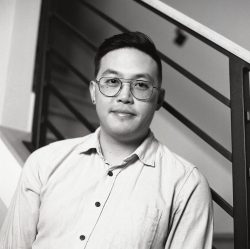
Travis Chi Wing Lau (he/him/his) is Assistant Professor of English at Kenyon College. His research and teaching focus on eighteenth- and nineteenth-century British literature and culture, health humanities, and disability studies. Alongside his scholarship, he has been published widely in venues of public scholarship and poetry, including three chapbooks—The Bone Setter (Damaged Goods Press, 2019), Paring (Finishing Line Press, 2020), Vagaries (Fork Tine Press, 2022)—and a full-length collection of poems, What’s Left Is Tender (Harbor Editions, 2025). He is also co-editor of Every Place on the Map Is Disabled, an anthology of disability poetry and poetics published with Northwestern University Press in 2026. He was the winner of the Christopher Hewitt Award for Poetry (2019), recipient of the Greater Columbus Arts Council’s Artists Elevated Award in Literature (2024), and the Ohio Arts Council's Artists with Disabilities Access Program Grant (2025).